
Rendering converts animal by-products from the meat and livestock industry into high value, sustainable products with a range of applications, such as animal feed and pet food. Rendering makes a significant contribution to European circular economy objectives by ensuring that animal by-products are not wasted, and the derived products are returned to the value chain.
Stakeholders along the value chain are increasingly requesting information on the environmental performance of rendered products to quantify their contribution to global warming and water usage. The European Fat Processors and Renderers Association (EFPRA), representing Europe’s fat melting and rendering industry, has generated high quality environmental data for 12 rendered products, as EU representative averages.
“Our industry has always worked on the principle that nothing is wasted. Safely processing and reusing animal by-products is an example of the circular economy in action; but it is important to verify these claims with hard evidence, that is why we commissioned these studies.”
Richard van Lijssel, Chairman of the EFPRA Sustainability Committee.
In collaboration with Mérieux NutriSciences | Blonk, an internationally renowned and independent consultancy, the carbon and water footprints of rendered products were calculated according to the Life Cycle Assessment (LCA) methodology, as described in international standards ISO 14040 and ISO 14044. This study is verified for GFLI compliance and is publicly available on the Global Feed LCA Institute (GFLI) database, an independent feed industry initiative. It has not been externally verified for ISO compliance. The GFLI database has evolved over several years using methodology developed to the highest standards, in accordance with the LEAP Guidelines and Feed PEFCR.
Methodology
The carbon and water footprint for rendered products are calculated from “cradle to rendering factory gate.” The system boundary shown in Figure 1 comprises the European animal farming system (including the production of animal feed), slaughterhouses, transport to rendering and operations for rendering into end-products. Transport of products to the customer (e.g. feed producers) is out of scope.

Figure 1: LCA System Boundary
Animal farm data was mostly taken from publicly available data, national statistics and literature. Transport and energy use at slaughterhouses are based on the default GFLI process. Rendering operations data were gathered from EFPRA members, covering 48 production lines for the years 2020–2022. The purpose of this assessment was to update the 2016-2018 EFPRA GFLI results and include the water footprint for the first time.
Category 3 rendering operations produce processed animal protein (meal) and fat (oils). The impact at rendering is allocated to these two co-products based on their ex-work prices. In accordance with the GFLI methodology, mass and energy allocation are also calculated and included in the GFLI database but this publication only includes the economic allocation results.
The GFLI results are calculated for both the ReCiPe 2016 and the EF 3.1 Method and are published as such in the GFLI database. In the document, the results presented are from the ReCiPe 2016 methodology.
The data collected for EFPRA is considered of high quality, based on primary information of rendering while the plant-based alternatives are derived from a commercial LCA database, largely relying of secondary information. There is therefore an uncertainty regarding the representativeness of the plant-based alternatives and therefore the validity of such a comparison. We can therefore conclude that such a comparison, is only meant to serve as a benchmark, in order to provide an indication of the corresponding impact of alternative ingredients.
Results: Global Warming Contribution
Carbon footprint is the index used to express the global warming potential of a production system, expressed in kg CO2 eq. The total global warming contribution for each rendered product is calculated based on the weighted average of all companies’ data, per production line. All models are aligned to the GFLI methodology. The LCA primarily focuses on climate change, as one of the most relevant impact categories in the Feed PEFCR, it is the impact category of greatest interest to EFPRA members and their stakeholders.
The climate change impact shown in Figure 2 ranges from 0.71 to 4.03 kg CO2 eq. per kg rendered product. Farm emissions (including crop cultivation) vary from 15% to 80% of the total impact, depending on the economic value of animal by-products at the slaughterhouse. Therefore, the contribution of rendering varies from 10% to 70% of the total impact. Energy use at slaughterhouses and transport to the rendering facility are less significant.

Figure 2: Global Warming Contribution (per kg rendered product)
Note: Land Use Change (LUC) refers to changes in the purposes for which land is used by humans (e.g. between crop land, grass land, forest land, wetland, industrial land). Land use has a direct impact on climate change when the transformation of land reduces carbon stocks and/or generates greenhouse gas emissions during removal. In LCA, land use change is considered when having occurred within the last 20 years.
Comparison with plant-based alternatives
Comparing the climate change impact of rendered products with plant-based alternatives allows us to evaluate the merits of different ingredients. To fairly calculate the data for plant-based alternatives, the figures are an average based on the volumes of a particular EU feed ingredient containing a blend of plant material of EU and non-EU origin.
The LCA results in Figures 3 and 4 show that plant-based alternatives (like soybean and palm) have a higher carbon footprint than rendered products while rapeseed products are the best performing plant-based material with a similar impact to rendered products.

Figure 3: Global Warming Contribution (per kg protein)
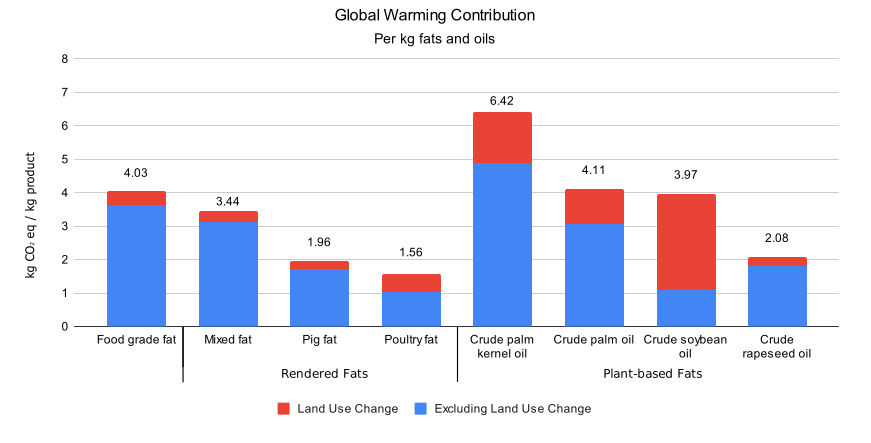
Figure 4: Global Warming Contribution (per kg fats and oils)
Plant-based sources have a high share of agriculture activities associated to production, some plant-based sources are highly associated with deforestation. In the case of rendered products, the majority of agriculture and animal farming impact is allocated to the production of fresh meat.
Soybean meal and palm fat, respectively have the highest carbon footprint of all the evaluated proteins and fats because they are mainly sourced from countries of land use change. Rapeseed meal has a higher carbon footprint than most rendered products, due to its relatively low protein content.
In conclusion, nearly all rendered products have lower CO2 equivalent emissions than the plant based alternatives and are a sustainable option for use in animal feed.
Results: Water Footprint
Freshwater is a scarce resource, which cannot be replaced by other resources. For agricultural and industrial processes a significant amount of water is used, either for irrigation, cooling or washing. Different sources of water can be used such as ground water, surface water or tap water. Depending on the process, water use influences the (future) availability of the water.
In LCA studies, water use and water consumption are often used interchangeably but are not the same:
- “Water use” refers to the total amount of water withdrawn from a water source.
- “Water consumption” refers to water used which does not return to the original water source – i.e it is evaporated, incorporated into products, transferred to other watersheds or disposed into the sea.
The LCA study of rendered products covers water use which is reported by the participating companies. Figure 5 shows the water footprint per kg of rendered product.

Figure 5: Total Water Use (per kg rendered product from cradle to exit)
Water use per kg product ranges from 6.56 – 15.26 litres for PAPs and meals and from 17.79 – 24.4 litres for fats and oils. The rendering only contribution varies from 0.49 – 4.66 litres and is between 7% – 67% of the total impact depending on the product.
Participating companies reported sources of used water as tap, surface and ground water. Tap water is sourced from surface and ground water; however, and according to the European Environment Agency groundwater supplies 65% of drinking water, so we can safely assume the rest is surface water. Based on this assumption the ground water use at the rendering plant varies between 13 – 80% of the total water use.
Comparison with plant-based alternatives
The water footprint of rendered products is compared to plant-based alternatives to evaluate the overall impact. The water use of plant-based meals and oils is shown in Figure 6 below.

Figure 6: Water Use – Plant-based Alternatives to Rendered Products (EU market mix from cradle to exit)
The footprint of plant-based meals ranges from 1.76 – 14.22 litres / per kg and plant-based oils range from 4.1 – 60.05 litres / kg. Rapeseed meal has a lower water footprint than rendered meals while soybean meal has a higher water footprint. Plant-based oils mostly have lower water footprints than rendered oils except for crude soybean oil.
Plant-based meals are lower in protein content than rendered meals however, which increases their relative impact when compared to rendered meals. Figure 7 shows the comparison between rendered meals and plant-based meals on a protein basis.

Figure 7: Water Use – Rendered and Plant-based Meals (litres water per kg protein from cradle to exit)
Limitations
The data collected for EFPRA is considered of high quality, based on primary information of rendering while the plant-based alternatives are derived from a commercial LCA database, largely relying of secondary information. There is therefore an uncertainty regarding the representativeness of the plant-based alternatives, and it is only meant to serve as a benchmark not a definitive comparison.